











Project Harbor Station Square: Outdoor WiFi Coverage Solution for a Busy Transit Plaza in Vancouver
Contractor Team Introduction
We are a local WiFi engineering contractor with deep experience in outdoor public WiFi coverage, transportation hub networks, station square wireless systems, CCTV wireless transmission, commercial plaza WiFi, hotel WiFi, mall WiFi, public service hall networks, warehouse wireless systems, and managed network deployment for high traffic environments. Our team has worked on projects involving railway station forecourts, bus transfer areas, taxi pickup zones, outdoor commercial plazas, campus public spaces, parking entrances, security posts, and remote monitoring points.
A station square network is not the same as ordinary outdoor WiFi. Passengers arrive in waves, connect for short periods, move quickly between entrances and transport zones, and often gather in queues. At the same time, station staff, security personnel, retail tenants, POS devices, CCTV cameras, ticketing support devices, and management equipment also depend on the same outdoor network environment. A successful project must consider passenger flow, high peak density, weather exposure, metal shelters, vehicle areas, wireless bridge paths, network isolation, AP placement, PoE power, and long term maintenance.
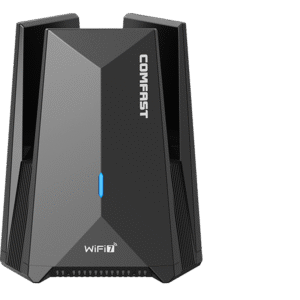
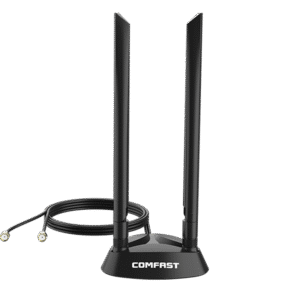
We have used COMFAST equipment in many outdoor WiFi and wireless transmission projects. From our field experience, COMFAST outdoor APs, core gateways, PoE switches, and wireless bridges provide a practical balance of stable performance, clean installation, centralized management, and cost efficiency. For this station square project, we selected COMFAST CF-WA973 outdoor WiFi 7 APs, CF-EW87 outdoor WiFi 7 APs, CF-E115A 5.8G wireless bridges, CF-AC200 full gigabit core gateway, and CF-SG1241P 24 port gigabit PoE switch to build a stable outdoor WiFi and CCTV transmission system.
This case study documents our Station Square Coverage Solution for Harbor Station Square in Vancouver. The project covered the main station entrance, outdoor passenger square, ticket hall exterior, passenger queue area, taxi pickup zone, bus transfer area, ride hailing waiting zone, pedestrian walkway, outdoor rest area, retail kiosk zone, security booth, parking entrance, remote CCTV points, and network equipment room.
1. Project Overview
Basic Project Information
Project Name: Project Harbor Station Square
Project Location: Vancouver, British Columbia, Canada
Facility Type: Railway station outdoor transit plaza and station forecourt
Outdoor Coverage Area: Approximately 31,000 square meters
Average Daily Passenger Flow: Around 42,000 passengers
Peak Hour Passenger Flow: Around 6,500 passengers during morning and evening rush periods
Main Coverage Areas: Station entrance, main square, passenger queue area, taxi pickup zone, bus transfer area, ride hailing waiting zone, pedestrian walkway, outdoor rest area, retail kiosk zone, security booth, parking entrance, and CCTV transmission points
Project Type: Station Square Coverage Solution with outdoor WiFi 7 APs, segmented networks, and 5.8G wireless bridge CCTV backhaul
Project Cycle: Five weeks from site survey to final acceptance
Construction Window: Overnight and low traffic periods, with phased work zones to avoid passenger disruption
Harbor Station Square had indoor WiFi in the station building, but the outdoor square relied on weak signal leaking from the station entrance. That approach could not support passengers waiting outside, bus transfer users, taxi coordinators, retail kiosks, and security camera backhaul. The station operations team needed a professional outdoor wireless system that could support public connectivity and operational devices without affecting daily passenger movement.
2. Customer Pain Points Before the Project
Outdoor Square WiFi Was Weak and Unstable
The existing indoor APs could not provide reliable outdoor coverage. Passengers near the station doors could sometimes connect, but signal dropped quickly in the middle of the square. The problem became worse when the square was crowded, because too many users tried to connect through weak edge coverage.
Passenger Queue Areas Had Poor Connectivity
The passenger queue areas outside the ticket hall and bus transfer zone had inconsistent WiFi. During peak hours, passengers used mobile tickets, transport apps, ride hailing apps, and messaging at the same time. The old network could not support that short term concentration of connections.
Taxi and Bus Operation Zones Had No Reliable Outdoor WiFi
Taxi coordinators and bus operations staff used handheld devices, communication apps, and service tablets. These areas were too far from the indoor APs, and vehicle movement created additional wireless challenges. The operations team needed dedicated outdoor coverage for these zones.
Retail Kiosk POS Devices Occasionally Dropped
Retail kiosks around the station square used POS terminals and cloud based inventory tools. When the public WiFi became unstable, retail tenants experienced payment delays and occasional POS reconnection issues. The station wanted the merchant network separated from general passenger WiFi.
Parking Entrance CCTV Backhaul Was Not Stable
Several CCTV points near the parking entrance and remote square edge were not close to existing Ethernet drops. Pulling new cable would require pavement work and lane coordination. The customer needed a stable wireless bridge solution for remote camera transmission.
Metal Shelters and Advertising Boards Affected Wireless Coverage
The outdoor square had metal taxi shelters, bus stop roofs, signage frames, digital advertising displays, lighting poles, and glass structures. These materials reflected or blocked wireless signal, which made simple AP placement unreliable.
Network Groups Were Not Properly Separated
Passenger devices, staff devices, retail POS units, cameras, and management access were not clearly separated in the previous outdoor setup. This made troubleshooting difficult and increased the risk of public traffic affecting station operations.
3. Customer Requirements
Confirmed Requirements from Station Management
Stable outdoor WiFi coverage across the station square.
Reliable passenger WiFi in the entrance area, queue area, pedestrian walkway, and outdoor rest area.
Dedicated coverage for taxi pickup zone, bus transfer area, and ride hailing waiting zone.
Stable merchant and POS network for retail kiosks.
Stable staff network for station operations and security devices.
Reliable 5.8G wireless bridge transmission for parking entrance and remote CCTV points.
Passenger WiFi separated from staff, merchant, camera, and management networks.
Centralized PoE power supply for outdoor APs and bridge devices.
Outdoor devices suitable for rain, wind, dust, sun exposure, and long term public area installation.
Clean installation without exposed messy cabling.
Deployment without disrupting station operations, passenger flow, bus movement, taxi loading, or retail business.
4. COMFAST Equipment Used in This Project
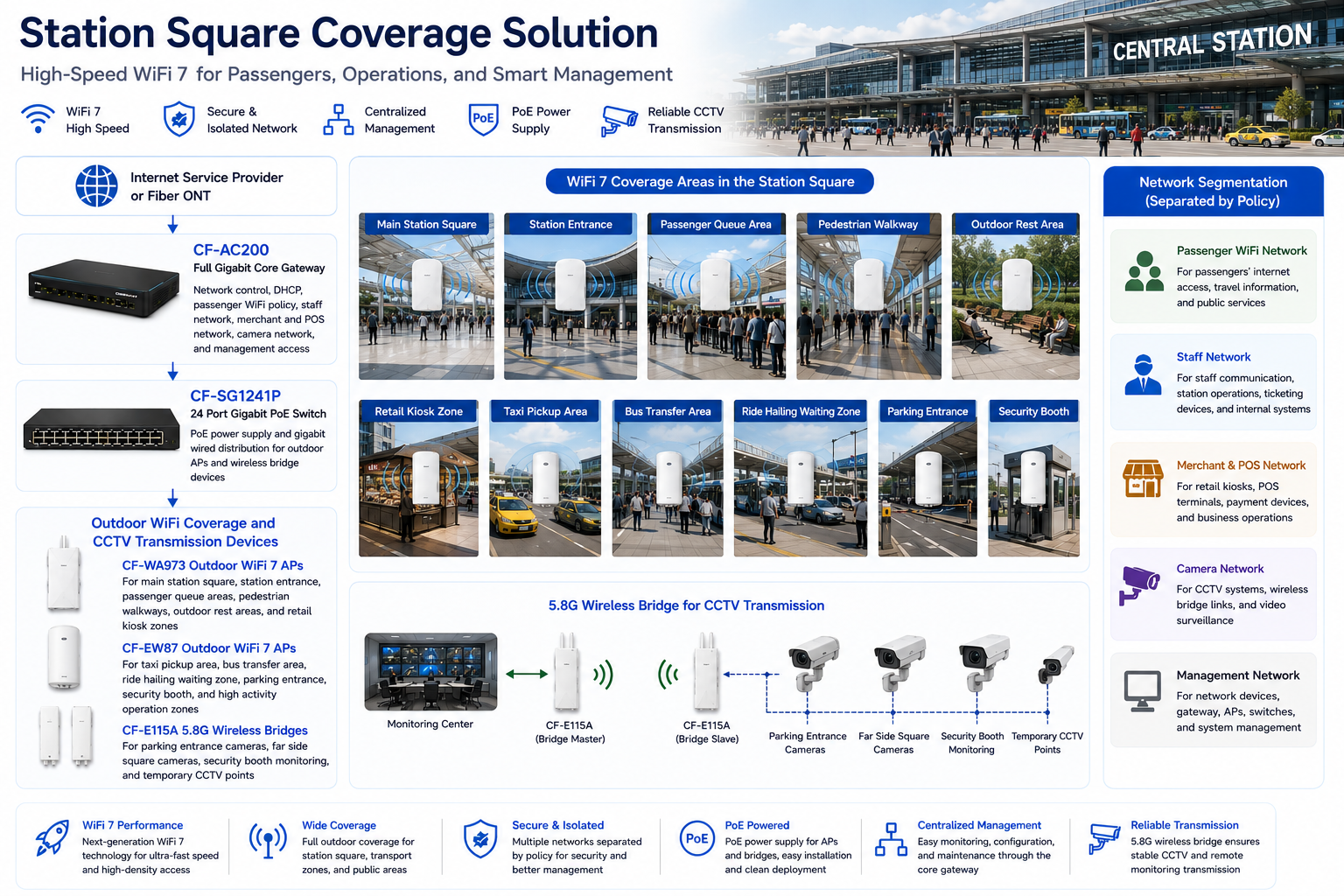
CF-AC200 Full Gigabit Core Gateway
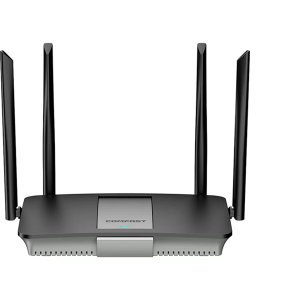
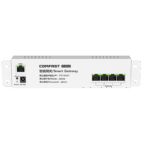
The CF-AC200 was used as the full gigabit core gateway. It handled network control, DHCP, passenger WiFi policy, staff network policy, merchant and POS network policy, camera network planning, and management access. For a station square project, the gateway must keep public passenger access from affecting operational and security devices.
CF-SG1241P 24 Port Gigabit PoE Switch
The CF-SG1241P 24 port gigabit PoE switch was used for centralized PoE power and wired distribution. It powered outdoor APs, bridge devices, and selected network points. The 24 port capacity also gave the station space for future expansion, such as additional cameras, retail kiosks, or temporary event APs.
CF-WA973 Outdoor WiFi 7 AP
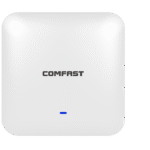
The CF-WA973 outdoor WiFi 7 AP was used for the main station square, passenger queue areas, station entrance exterior, pedestrian walkways, outdoor rest areas, and retail kiosk surroundings. It provided wide outdoor coverage for passenger and public access zones.
CF-EW87 Outdoor WiFi 7 AP
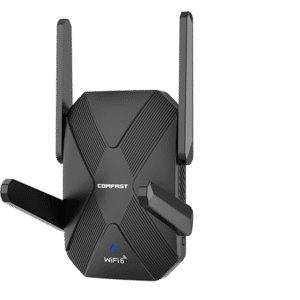
The CF-EW87 outdoor WiFi 7 AP was used in high activity and vehicle operation zones, including the taxi pickup area, bus transfer area, ride hailing waiting zone, parking entrance, and security booth surroundings. These areas needed focused outdoor coverage for staff devices and passengers moving through transport zones.
CF-E115A 5.8G Wireless Bridge
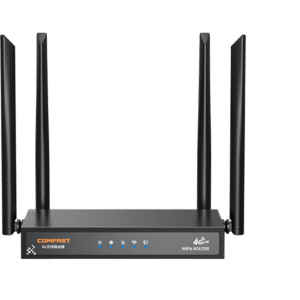
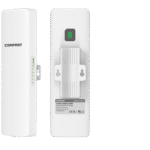
The CF-E115A wireless bridge was used for 5.8G CCTV transmission. It connected remote camera points at the parking entrance, far side of the station square, and temporary monitoring positions where trenching or new Ethernet cable installation was not practical.
5. Project Topology Diagram
Overall Network Topology
6. Site Survey and Troubleshooting Process
Passenger Flow and Outdoor RF Survey
We walked the station square with the operations manager, IT supervisor, security supervisor, and facilities team. We tested signal from the station entrance, queue lines, bus shelters, taxi loading lanes, ride hailing area, retail kiosks, outdoor benches, pedestrian crossings, parking entrance, and camera locations. We focused on real passenger positions instead of only testing near the station building.
Peak Hour Observation
We observed morning and evening rush hour movement. Passenger density was highest near the entrance, queue rails, bus transfer area, and taxi pickup zone. Many users connected for only a short period, which required fast and stable association rather than only long range signal.
Shelter, Signage, and Metal Structure Inspection
The station square had metal rain shelters, digital advertising boards, glass railings, bus stop roofs, taxi lane signs, lighting poles, and camera poles. These structures affected AP placement and bridge paths. Several original mounting ideas were changed after field inspection.
Retail Kiosk and POS Network Review
Retail kiosks needed stable POS connectivity and should not depend on general passenger WiFi. We reviewed kiosk locations, payment terminal positions, and cable availability. This helped us design a separated merchant and POS network.
CCTV Point and Wireless Bridge Path Survey
We checked camera locations at the parking entrance, far side of the square, security booth, and temporary event monitoring positions. For every CF-E115A bridge link, we confirmed line of sight, mounting height, cable route, power availability, and possible obstruction from buses, trees, and signage.
Equipment Room and PoE Readiness Check
The station equipment room already had fiber access and cabinet space, but some patch cables were not labeled clearly. We tested existing routes, prepared the CF-AC200 gateway location, installed the CF-SG1241P PoE switch, and created a clear port map for outdoor APs and wireless bridge devices.
7. Problems Found During Implementation
Indoor WiFi Could Not Serve the Outdoor Square
The original design depended on indoor WiFi leaking through the station entrance. That was not a real outdoor coverage solution. Exterior glass, wall structure, distance, and passenger density made the signal unreliable. Dedicated outdoor APs were required.
Vehicle Operation Zones Needed Separate Planning
Taxi and bus areas had moving vehicles, metal shelters, passenger queues, and staff devices. These zones could not rely on APs aimed only at the main square. We used CF-EW87 APs to provide focused coverage in these operation areas.
Retail POS Traffic Needed Isolation
Retail POS devices needed stability during passenger rush hours. We separated merchant and POS traffic from public passenger WiFi so payment devices would not be affected by general browsing or short term public connections.
Remote Camera Points Were Not Suitable for Trenching
Parking entrance and far side square cameras were difficult to cable. Trenching would disrupt vehicle movement and public walking paths. CF-E115A 5.8G wireless bridges provided stable CCTV backhaul without major civil work.
Outdoor APs Required Careful Channel and Power Tuning
Outdoor APs can cover wide areas, but maximum power creates overlap and interference. We tuned channels and transmit power to support passenger movement and reduce unnecessary AP competition.
Construction Had to Avoid Station Disruption
The station square stayed open during the project. We worked zone by zone during approved low traffic windows. This allowed installation to proceed without blocking passenger routes, taxi loading, bus movement, or retail operations.
8. Final Engineering Solution
Core Gateway and Policy Control
We installed the CF-AC200 full gigabit core gateway as the main network control point. It handled DHCP, passenger WiFi policy, staff network policy, merchant and POS access, camera traffic, and management access. This gave the station a clean and controlled network foundation.
Centralized PoE Distribution
The CF-SG1241P 24 port gigabit PoE switch powered outdoor APs and wireless bridge devices. Each device port was labeled in the equipment room. Centralized PoE power made the system safer, cleaner, and easier to maintain.
Outdoor WiFi 7 AP Coverage
CF-WA973 APs were deployed for the main station square, passenger queue areas, pedestrian walkways, outdoor rest areas, entrance exterior, and retail kiosk zones. CF-EW87 APs were used for taxi pickup, bus transfer, ride hailing waiting, security booth, and parking entrance zones.
5.8G CCTV Wireless Bridge Transmission
CF-E115A wireless bridges were installed for remote CCTV transmission. We used them for parking entrance cameras, far side square cameras, and temporary monitoring points where direct cabling was not practical.
Network Segmentation
We separated passenger WiFi, staff network, merchant and POS network, camera network, and management network by policy. This improved security, reduced interference between user groups, and made troubleshooting easier.
9. Different Area Network Design
Station Entrance Coverage
The station entrance required smooth transition between indoor and outdoor areas. CF-WA973 APs were positioned to cover passengers entering and exiting the station without relying on indoor signal leakage.
Main Square Coverage
The main square was the largest public area. AP placement was planned around actual passenger gathering points, walking paths, signage structures, benches, and temporary event zones.
Passenger Queue Area Coverage
Queue areas near the ticket hall and bus transfer zone required stronger capacity. Passengers used mobile tickets, transport apps, and ride hailing apps while waiting. We designed coverage for short term high density connection behavior.
Taxi Pickup Area Coverage
The taxi pickup zone used CF-EW87 APs for focused coverage. Taxi coordinators and station staff needed stable handheld access while passengers used transport apps and messaging services.
Bus Transfer Area Coverage
The bus transfer area had shelters, metal frames, signage, and moving vehicles. APs were mounted to provide coverage under and around shelters while reducing obstruction from large vehicles.
Ride Hailing Waiting Area Coverage
The ride hailing zone required stable WiFi for app based pickup coordination. We designed coverage for passengers standing with luggage and moving between marked pickup points.
Retail Kiosk and POS Network
Retail kiosks were placed on a separated merchant and POS network. This protected payment terminals from public passenger traffic and improved POS stability during rush hours.
Security Booth Coverage
The security booth needed staff access, camera viewing, and communication support. We provided local outdoor coverage and connected related CCTV points through the camera network.
Parking Entrance and CCTV Transmission
Parking entrance camera transmission used CF-E115A wireless bridges. This avoided trenching and supported stable video monitoring from the security center.
10. Outdoor AP Placement and Installation Details
Mounting Height and Coverage Direction
We selected AP mounting heights based on passenger position, structure availability, safety requirements, and maintenance access. Each AP was aimed toward real user areas rather than empty vehicle lanes or building walls.
Weather Resistant Installation
Outdoor equipment was installed with attention to rain exposure, cable entry direction, mounting firmness, drip loops, and service access. The installation was designed for long term outdoor operation.
Channel and Power Optimization
After installation, we tuned AP channels and transmit power. This reduced overlap, improved passenger roaming, and helped avoid interference between the main square, taxi area, and bus transfer zone.
Device Labeling
Every AP and bridge device was labeled according to its location and switch port. This made future maintenance easier for the station IT team.
11. Wireless Bridge Transmission Design
Parking Entrance Camera Bridge
The parking entrance camera point was connected by CF-E115A wireless bridge. We selected mounting points with clear line of sight and stable power access. This avoided pavement work and lane interruption.
Far Side Square Camera Bridge
The far side camera point monitored pedestrian movement and public safety. A wireless bridge link was used because direct cabling would have required disruptive outdoor construction.
Temporary Event Monitoring Bridge
The station occasionally hosted public announcements and temporary crowd control events. We reserved bridge planning options for temporary monitoring points, allowing the station to expand CCTV coverage when needed.
Bridge Stability Testing
Each CF-E115A bridge link was aligned and tested for video continuity. We checked link stability, camera feed delay, and monitoring center video quality before final handover.
12. Network Segmentation and Security Design
Passenger WiFi Network
The passenger WiFi network provided public internet access for travelers. It was isolated from staff, merchant, camera, and management systems.
Staff Network
The staff network supported station operations, security devices, taxi coordination, and bus operations staff. It was protected from public passenger traffic.
Merchant and POS Network
The merchant and POS network supported retail kiosks, payment terminals, and service counters. This network was separated for transaction stability.
Camera Network
The camera network carried CCTV traffic from fixed cameras and CF-E115A wireless bridge links. This made monitoring more stable and troubleshooting easier.
Management Network
The management network was reserved for gateway, switch, outdoor AP, and wireless bridge maintenance. Access was restricted to authorized IT staff.
13. What We Did Differently from Other Engineering Teams
We Did Not Treat Outdoor Coverage as Indoor Signal Extension
Some teams try to place indoor APs near glass walls and call it outdoor coverage. We designed the square as a real outdoor public network with proper outdoor APs, weather resistant installation, and field testing.
We Tested Real Passenger Movement
We tested passengers moving from the station entrance to taxi pickup, from bus transfer to the main square, from retail kiosks to the parking entrance, and from the queue area to pedestrian walkways. The design followed actual movement, not only map distance.
We Protected Operational Networks
Passenger WiFi was separated from staff, merchant, CCTV, and management traffic. This protected station operations and retail POS devices during peak passenger load.
We Used Wireless Bridges Instead of Disruptive Trenching
For remote camera points, we used CF-E115A 5.8G wireless bridges instead of recommending pavement cutting and lane closures. This reduced construction impact and kept the station open.
We Delivered a Maintainable System
The station received AP location records, bridge link records, port labels, topology notes, and basic troubleshooting guidance. The system was built to be maintained, not just installed.
14. Project Acceptance Results
Final Acceptance Checklist
Station entrance outdoor WiFi test passed.
Main station square coverage test passed.
Passenger queue area high user simulation passed.
Taxi pickup area staff device test passed.
Bus transfer area WiFi test passed.
Ride hailing waiting zone test passed.
Retail kiosk POS network test passed.
Security booth network test passed.
Parking entrance camera bridge test passed.
Remote CCTV bridge transmission test passed.
Passenger, staff, merchant, camera, and management network separation test passed.
Device labels, AP location map, bridge records, topology notes, and IT handover completed.
15. Customer and User Feedback
Station Operations Manager Feedback
The station operations manager said, “The square now has stable outdoor WiFi coverage, and the installation did not interrupt station service. The taxi and bus areas are finally covered properly.”
IT Supervisor Feedback
The IT supervisor said, “The network documentation is clear. We know which AP covers each area, which switch port powers each device, and which bridge handles each camera link.”
Security Supervisor Feedback
The security supervisor confirmed that the parking entrance and far side square camera feeds became more stable after the CF-E115A bridge deployment.
Retail Tenant Feedback
A retail tenant said, “Our POS terminals are more stable during rush hours. Payment delays have dropped noticeably.”
Passenger Feedback
Passengers reported better connection in the main square, queue area, and ride hailing waiting zone. Several users noted that transport apps loaded faster while waiting outside the station.
16. Project Summary
Final Result
Project Harbor Station Square was a successful Station Square Coverage Solution for a busy transit plaza in Vancouver. The project solved weak outdoor WiFi, poor queue area connectivity, uncovered taxi and bus zones, unstable retail POS access, difficult CCTV backhaul, and mixed network traffic.
The final COMFAST solution used the CF-AC200 full gigabit core gateway, CF-SG1241P 24 port gigabit PoE switch, CF-WA973 outdoor WiFi 7 APs, CF-EW87 outdoor WiFi 7 APs, and CF-E115A 5.8G wireless bridges. The system provided stable outdoor coverage, centralized PoE power, network segmentation, and reliable wireless CCTV transmission.
The key value of this project was not simply adding outdoor APs. The real value was building a station square network around passenger movement, transport operations, retail payment stability, CCTV monitoring, and long term maintenance.
17. Lessons Learned and Advice to Other Contractors
Lessons Learned
Station square WiFi must be designed as a real outdoor system, not as indoor signal extension.
Passenger flow and queue density are more important than simple map distance.
Taxi, bus, and ride hailing zones require independent coverage planning.
Retail POS traffic must be separated from public passenger WiFi.
Wireless bridges are useful for remote CCTV points where trenching would disrupt operations.
Outdoor AP channels and power must be tuned carefully to reduce interference.
A maintainable station network requires AP labels, bridge records, port maps, and handover documentation.
Advice to Other WiFi Engineering Contractors
For station square projects, do not design only from drawings. Walk the square during real passenger flow. Stand in the queue area, taxi lane, bus shelter, ride hailing zone, retail kiosk area, and parking entrance. The network must follow how passengers and staff actually move.
Do not put passenger WiFi, staff devices, POS terminals, cameras, and management access on the same network. Public transportation environments need separation because passenger traffic changes quickly and can overload shared resources.
Do not recommend trenching before checking wireless bridge options. A properly aligned 5.8G bridge can reduce cost, shorten construction time, and avoid disrupting public areas.
A Station Square Coverage Solution is complete only when passengers can connect smoothly, staff devices remain stable, retail POS terminals keep working, cameras transmit reliably, and the station IT team can maintain the system confidently. That was the standard we delivered for Project Harbor Station Square.