










Project Andaman Breeze Resort: Outdoor WiFi Coverage and CCTV Wireless Transmission for a Beachfront Resort in Phuket
Contractor Team Introduction
We are a local Shenzhen WiFi engineering contractor based in Phuket with long term experience in resort WiFi coverage, hotel outdoor wireless networks, beachfront villa coverage, restaurant WiFi, shopping mall WiFi, marina WiFi, scenic area WiFi, CCTV wireless transmission, and managed network deployment for hospitality environments. Our team has completed wireless projects for boutique resorts, beachfront hotels, island restaurants, pool clubs, spa villas, ferry piers, and mixed indoor outdoor tourism properties.
A resort WiFi project is very different from a normal office or home network. Guests move between rooms, gardens, swimming pools, restaurants, beach paths, spa areas, reception, outdoor lounges, parking areas, and private villas. At the same time, the resort also needs stable connectivity for CCTV cameras, POS terminals, staff devices, guest services, maintenance teams, and back office management. A successful outdoor resort WiFi solution must consider guest experience, tropical weather, salt air, palm trees, pool water reflection, stone walls, garden structures, long walkways, remote cameras, and simple long term maintenance.
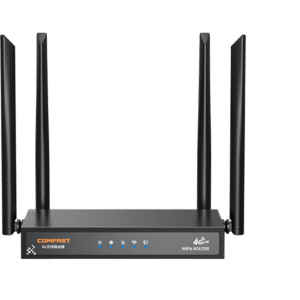
Our engineering team has used COMFAST equipment across many hospitality and outdoor wireless projects in Thailand. From our field experience, COMFAST outdoor APs, wireless bridges, gigabit gateways, and PoE switches provide a practical balance of stable performance, flexible installation, clean network management, and cost control. For this Phuket resort project, we selected COMFAST CF-WA973 WiFi 7 outdoor APs, CF-EW74 V2 dual band outdoor APs, CF-E113A V2 5.8G wireless bridges, CF-AC300 full gigabit core gateway, and CF-SG1241P 24 port gigabit PoE switch.
This case study documents our Outdoor WiFi Coverage Solution for Andaman Breeze Resort, a beachfront resort in Phuket. The project covered the resort entrance, reception exterior, garden walkways, beachfront lounge, swimming pool deck, outdoor restaurant, pool bar, spa garden, villa paths, family activity lawn, parking area, staff service route, security booth, beach access path, and remote CCTV camera points.
1. Project Overview
Basic Project Information
Project Name: Project Andaman Breeze Resort
Project Location: Phuket, Thailand
Property Type: Beachfront resort with villas, outdoor dining, pool area, spa garden, and beach access
Outdoor Coverage Area: Approximately 36,000 square meters
Guest Capacity: Around 280 guests at full occupancy
Main Coverage Areas: Resort entrance, reception exterior, tropical garden, villa walkways, swimming pool deck, pool bar, beachfront lounge, outdoor restaurant, spa garden, family activity lawn, parking area, beach access path, staff service route, and CCTV points
Project Type: Resort Outdoor WiFi Coverage Solution with guest WiFi, staff network, POS network, CCTV wireless bridge transmission, and management network separation
Project Cycle: Five weeks from site survey to final acceptance
Construction Window: Early morning, late night, and low guest traffic periods to avoid disturbing guests, restaurant service, pool use, and resort operations
Andaman Breeze Resort contacted us before the high season because its outdoor guest WiFi experience was no longer matching the resort’s service standard. Indoor room WiFi had been upgraded earlier, but the outdoor areas still had weak coverage, especially around the pool deck, beach path, spa garden, villa walkways, and remote CCTV points. The resort needed a professional outdoor wireless system that could support guest experience, staff operations, restaurant POS, and security monitoring at the same time.
2. Customer Pain Points Before the Project
Outdoor Guest WiFi Was Inconsistent
Guests had good WiFi inside most rooms, but the outdoor areas were inconsistent. The pool deck had signal near the building side but weak connection near sunbeds. The garden walkways had unstable roaming. The beachfront lounge had signal drops during sunset hours when many guests gathered at the same time.
Pool Area Needed Better High Density Coverage
The swimming pool deck was one of the resort’s busiest areas. Guests used phones, tablets, streaming apps, messaging apps, video calls, and social media while staying around the pool. The previous AP locations could not support this concentration of users, especially during late afternoon and weekend occupancy peaks.
Beachfront Lounge Had Weak Coverage
The beachfront lounge was separated from the main building by garden plants, palm trees, stone walls, and open-air structures. Indoor AP signal could not reach this area reliably. Guests often switched to mobile data while sitting at the beach bar or sunset seating area.
Outdoor Restaurant POS Was Not Stable Enough
The outdoor restaurant and pool bar used POS terminals, order tablets, and staff handheld devices. During busy dinner service, the POS devices occasionally experienced delays or reconnection issues. The resort needed the restaurant service network separated from guest WiFi traffic.
Villa Walkways Had Roaming Problems
Guests moved between villas, reception, restaurant, spa, pool, and beach access. The old outdoor wireless design did not provide smooth transition. Some guest devices stayed connected to a weak AP even after moving into another outdoor zone.
Remote CCTV Cameras Were Difficult to Cable
Several CCTV cameras around the beach access path, parking area, garden edge, and service route were far from the main network room. Running new Ethernet cable would require trenching through finished landscape areas and guest walkways. The resort needed wireless bridge transmission for these remote cameras.
Tropical Weather Damaged Temporary Installations
Some previous temporary devices were placed under roof edges or inside decorative covers. Phuket’s humidity, heavy rain, salt air, and heat affected those devices. The resort needed proper outdoor APs, clean PoE installation, protected cabling, and long term maintainable mounting.
Guest, Staff, POS, CCTV, and Management Traffic Were Not Clearly Separated
The previous network structure was too simple. Guest devices, staff devices, POS terminals, CCTV cameras, and management devices were not separated clearly. This made troubleshooting difficult and created unnecessary risk for resort operations.
3. Customer Requirements
Confirmed Requirements from Resort Management
Stable outdoor guest WiFi coverage across the resort’s main public areas.
Reliable WiFi around the pool deck, beachfront lounge, pool bar, spa garden, villa walkways, and outdoor restaurant.
Better capacity during breakfast, sunset, dinner service, and weekend occupancy peaks.
Stable POS and ordering network for outdoor restaurant and pool bar service.
Staff network coverage for service teams, maintenance teams, front desk mobility, and security staff.
Reliable wireless CCTV transmission for remote beach path cameras, parking cameras, and garden edge cameras.
Guest WiFi, staff network, POS network, CCTV network, and management network separated by policy.
Centralized PoE power for APs and wireless bridges.
Outdoor equipment suitable for humidity, rain, salt air, heat, insects, and long term resort use.
Clean installation that would not damage landscape design or affect the resort’s premium appearance.
Project delivery without disturbing guests, restaurant operations, pool activities, spa appointments, or beach access.
4. COMFAST Equipment Used in This Project
The following are the main COMFAST equipment models used in this project and their usage descriptions.
| Equipment Model |
Type | Project Use | Reason for Use |
|---|---|---|---|
| CF-AC300 | Full gigabit core gateway | Network control, DHCP, guest WiFi policy, staff network policy, POS and ordering network policy, CCTV network planning, and management access | Suitable as the resort core gateway, keeping guest traffic separated from POS, staff, CCTV, and management systems |
| CF-SG1241P | 24-port gigabit PoE switch | Centralized PoE power supply and wired distribution for outdoor APs, wireless bridge devices, and selected network points | Provides clean PoE deployment, reduces local adapters, simplifies maintenance, and reserves ports for future villas or event areas |
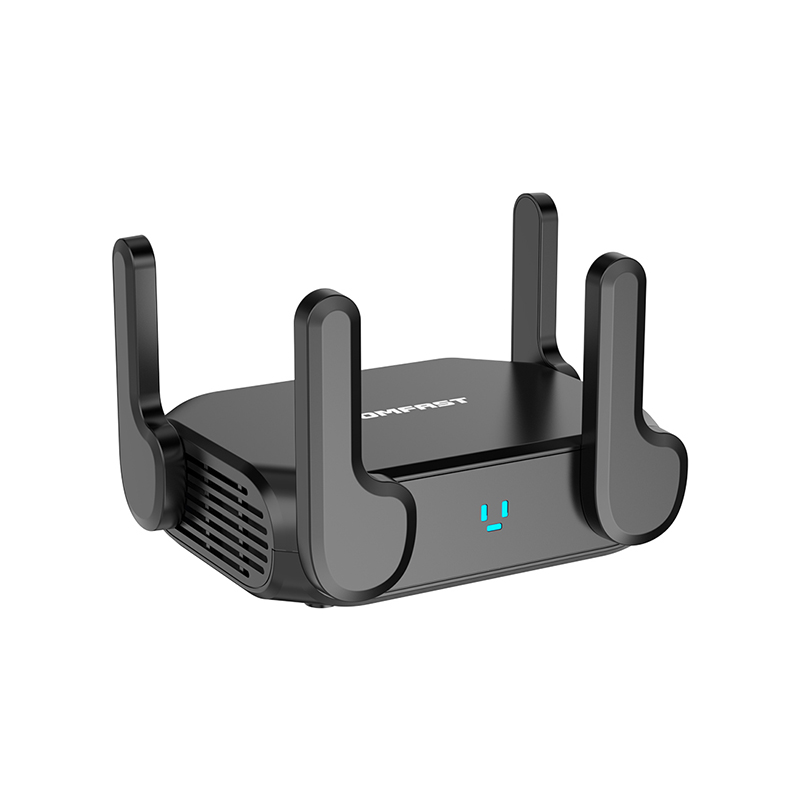
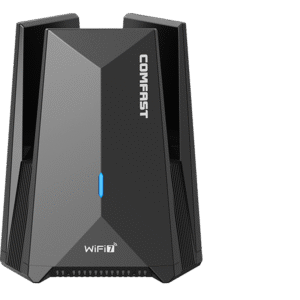
| CF-WA973 | Outdoor WiFi 7 AP | Pool deck, beachfront lounge, outdoor restaurant, pool bar, reception exterior, beach access path, and main garden area | Selected for high-traffic outdoor guest areas that need stronger capacity, better outdoor performance, and stable WiFi during peak resort hours |
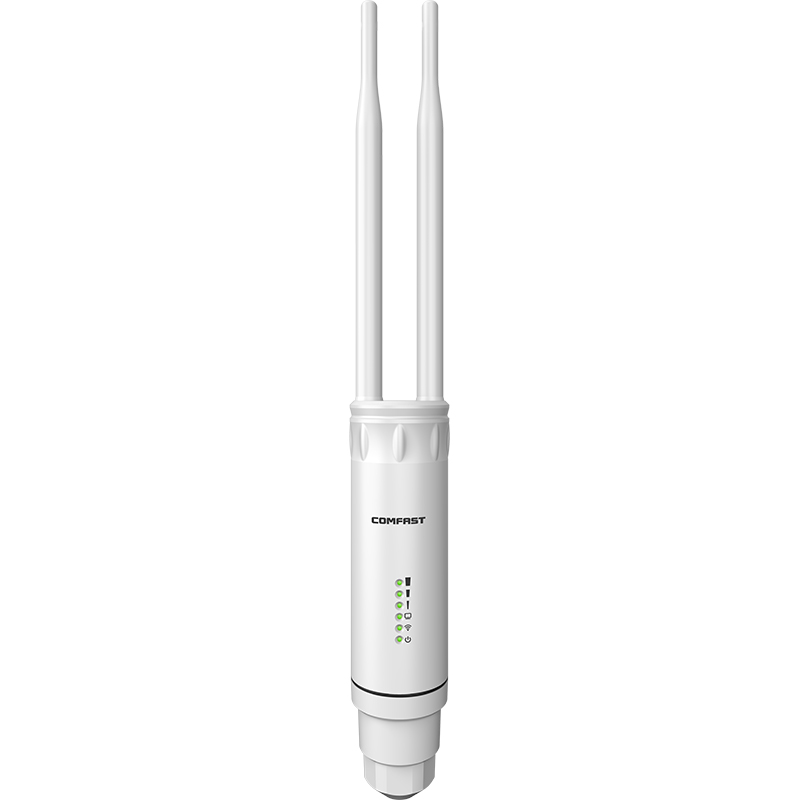
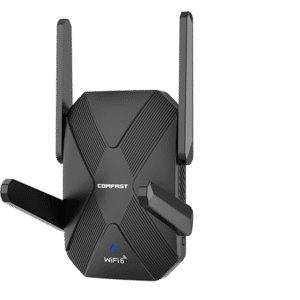
| CF-EW74 V2 | Dual-band outdoor AP | Villa walkways, staff service routes, parking edges, garden corners, spa exterior areas, and low to medium density outdoor paths | Used to fill secondary outdoor coverage gaps without overbuilding every resort zone with high-capacity APs |
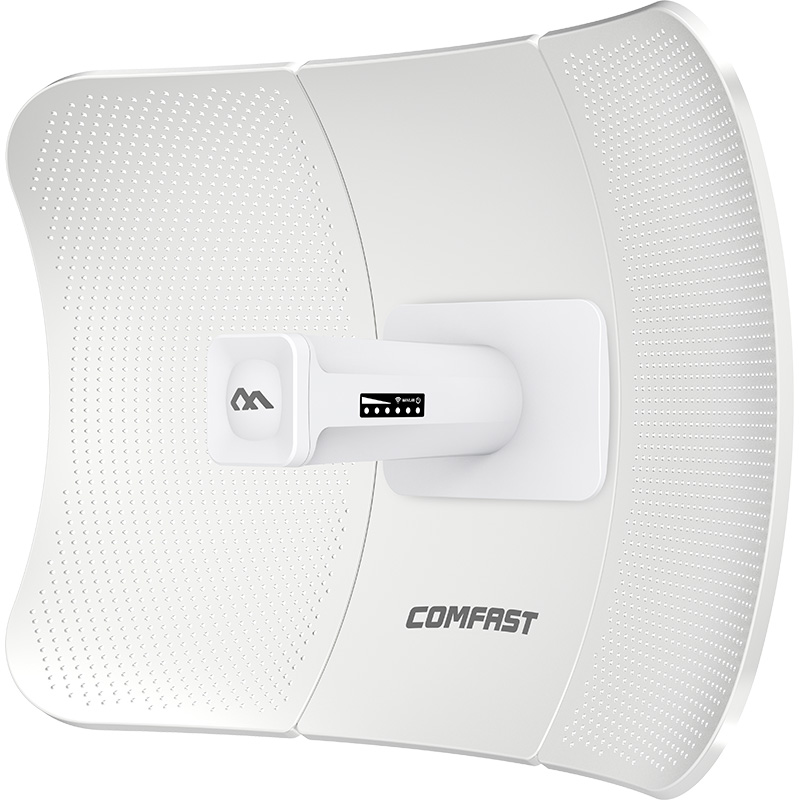
| CF-E113A V2 | 5.8G wireless bridge | CCTV wireless transmission for beach access path, parking area, garden edge, service route, and perimeter monitoring points | Avoids trenching through finished resort landscaping and guest walkways while maintaining stable remote CCTV backhaul |
5. Project Equipment Configuration Quantity
Based on the approximately 36,000 square meter beachfront resort outdoor area, around 280 guests at full occupancy, pool deck density, beachfront lounge usage, outdoor restaurant POS requirements, villa walkway roaming, parking area coverage, staff service routes, remote CCTV points, and future event expansion needs, the recommended equipment configuration for this project was as follows:
| Equipment Model | Quantity | Deployment Location |
|---|---|---|
| CF-AC300 | 1 unit | Resort equipment room, used as the full gigabit core gateway for guest WiFi, staff network, POS and ordering network, CCTV network, and management access |
| CF-SG1241P | 2 units | Main equipment room and outdoor distribution point, used for PoE power supply, AP connection, wireless bridge connection, uplink ports, and future expansion reserve |
| CF-WA973 | 10 units | Pool deck, sunbed area, pool bar, beachfront lounge, outdoor restaurant, reception exterior, beach access path, main garden area, and high-density guest gathering zones |
| CF-EW74 V2 | 8 units | Villa walkways, staff service routes, parking edges, garden corners, spa exterior areas, medium-density outdoor paths, and secondary resort transition areas |
| CF-E113A V2 | 5 pairs | Beach access path camera, parking area camera, garden edge camera, staff service route camera, and perimeter monitoring point where direct Ethernet cabling was not practical |
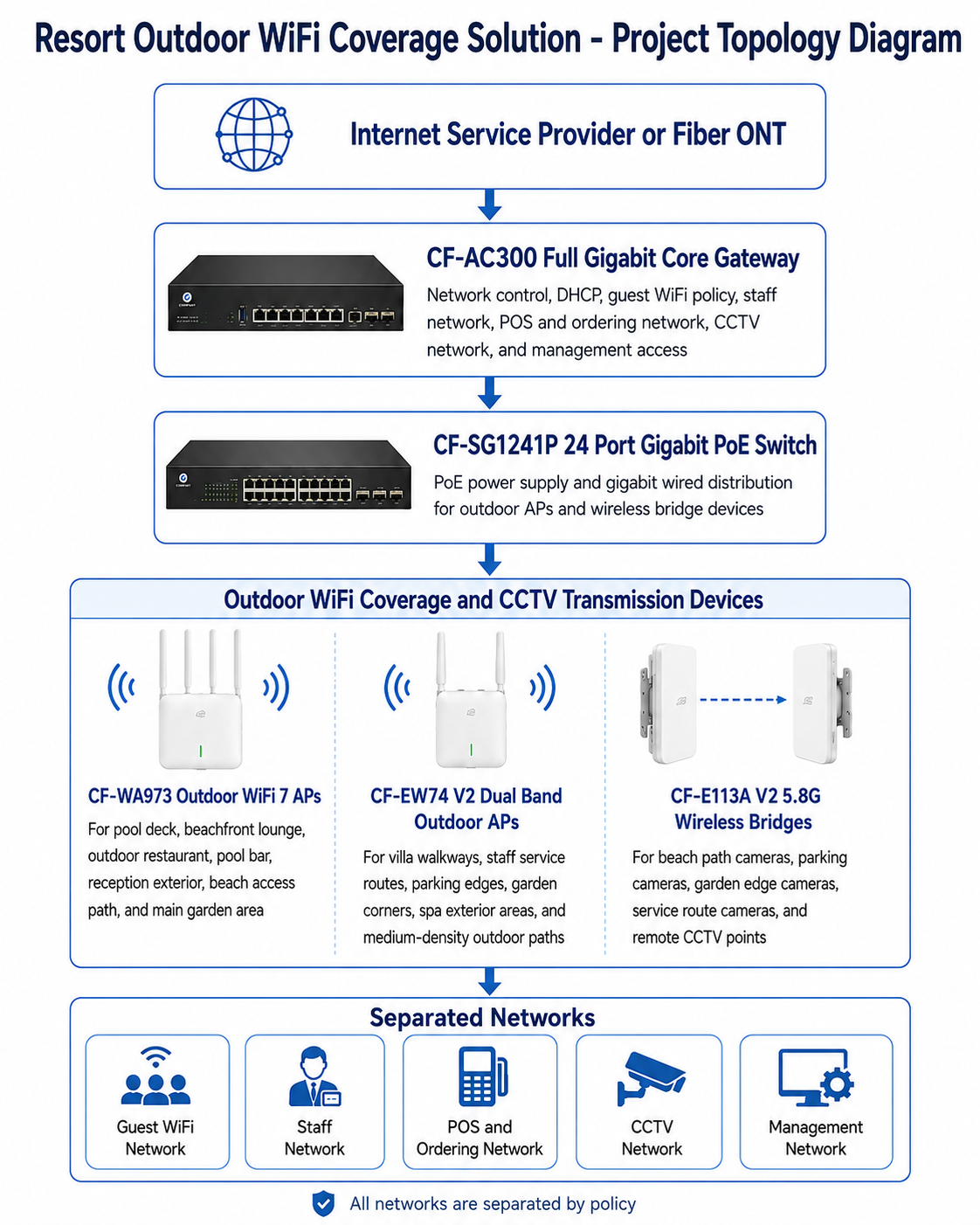
6. Project Topology Diagram
7. Site Survey and Troubleshooting Process
Guest Movement Survey
We started by walking the full guest path with the resort operations manager, IT supervisor, front office manager, and security supervisor. We followed the guest journey from arrival to reception, from reception to villa walkways, from villas to pool, from pool to outdoor restaurant, from restaurant to beachfront lounge, and from spa garden to beach access. This helped us design WiFi around real guest movement instead of only property drawings.
Outdoor RF Testing
We tested signal at the pool deck, sunbed area, pool bar, beachfront lounge, outdoor restaurant, garden pathways, villa corridors, spa exterior, parking lot, and staff service route. The old design showed signal in some areas, but actual throughput and stability were not good enough during busy hours.
Tropical Landscape and Obstruction Review
The resort had palm trees, dense tropical plants, stone walls, decorative wooden structures, water features, outdoor umbrellas, and roof edges. These elements affected WiFi coverage and bridge paths. We adjusted AP locations to cover guest areas while preserving the resort’s visual style.
Pool and Beachfront Density Evaluation
The pool deck and beachfront lounge had strong usage peaks. Guests gathered in the pool area during afternoon hours and near the beach during sunset. These areas needed high capacity AP planning instead of basic long range coverage.
Restaurant POS and Staff Device Review
We tested POS terminals, order tablets, and staff handheld devices in the outdoor restaurant, pool bar, and service stations. The POS network needed stable access and could not be exposed to guest WiFi congestion.
CCTV Wireless Bridge Path Survey
We inspected remote CCTV points at the beach path, parking area, garden edge, service route, and resort perimeter. For each CF-E113A V2 bridge link, we checked line of sight, mounting height, tree obstruction, cable route, power availability, and weather exposure.
Network Room and PoE Readiness Check
The resort’s equipment room had fiber access but old cable labels were incomplete. We tested cable routes, prepared the CF-AC300 gateway location, installed the CF-SG1241P PoE switch, and created a port map for APs and wireless bridges.
8. Problems Found During Implementation
Indoor WiFi Leakage Was Not Outdoor Resort Coverage
The previous system depended too much on indoor AP signal leaking into outdoor areas. That method created weak signal, poor roaming, and unstable guest experience. We designed a dedicated outdoor AP system for the resort’s actual outdoor zones.
Pool Water and Open Space Changed Signal Behavior
The pool deck had reflective surfaces, water, umbrellas, glass railings, and changing guest density. We placed CF-WA973 APs to cover active seating zones, not only the pool edge.
Palm Trees and Garden Walls Blocked Beachfront Signal
The beachfront lounge looked close to the main building on the map, but palm trees, stone landscape walls, and outdoor structures blocked signal. We used dedicated outdoor AP placement to serve the beachfront area directly.
Restaurant POS Needed Business Priority
POS and ordering devices could not share the same experience as general guest browsing. We separated POS and staff service devices from guest WiFi through gateway policy and AP planning.
Remote CCTV Cable Routes Would Damage Landscaping
Running cable to beach path cameras and garden edge cameras would have required work across finished landscape and guest walking zones. CF-E113A V2 wireless bridges provided a cleaner solution for CCTV transmission.
Salt Air and Humidity Required Better Installation Details
In a beachfront resort, outdoor devices must be installed carefully. We paid attention to mounting direction, cable entry protection, drip loops, corrosion risk, cleaning access, and exposure to salt air and tropical rain.
Installation Had to Protect Guest Experience
The resort stayed open during the project. We worked in early morning and late night windows, avoided noisy work near guest villas, and coordinated with restaurant and spa teams before entering service areas.
9. Final Engineering Solution
Core Gateway and Network Control
We installed the CF-AC300 full gigabit core gateway as the main network control point. It handled DHCP, guest WiFi policy, staff access, POS network, CCTV traffic, and management access. This allowed the resort to provide guest internet access without affecting business and security systems.
PoE Distribution
The CF-SG1241P 24 port gigabit PoE switch powered outdoor APs and wireless bridge devices. Centralized PoE reduced messy adapters, simplified maintenance, and gave the IT team a clearer device map.
High Traffic Outdoor WiFi 7 Coverage
CF-WA973 outdoor WiFi 7 APs were deployed in the pool deck, beachfront lounge, outdoor restaurant, pool bar, reception exterior, beach access path, and main garden area. These locations required stronger performance and better guest density support.
Secondary Outdoor Coverage
CF-EW74 V2 outdoor APs were installed for villa walkways, staff service routes, parking edges, garden corners, spa exterior, and medium density outdoor paths. This gave the resort broader coverage without overloading one AP type in every area.
CCTV Wireless Transmission
CF-E113A V2 5.8G wireless bridges were used for remote CCTV points at the beach path, parking area, garden edge, service route, and perimeter. This helped avoid disruptive trenching and protected the resort landscape.
Network Segmentation
We separated guest WiFi, staff network, POS and ordering network, CCTV network, and management network by policy. This improved security, service stability, and troubleshooting efficiency.
10. Different Area Network Design
Reception Exterior Coverage
The reception exterior needed WiFi for arriving guests, valet coordination, bell service, and staff tablets. CF-WA973 APs provided stronger coverage for arrival and departure activity without relying on indoor lobby APs.
Pool Deck Coverage
The pool deck was treated as a high density guest zone. We placed CF-WA973 APs to cover sunbeds, cabanas, pool bar seating, and family pool areas. Coverage was tested during real guest activity periods.
Pool Bar and Outdoor Restaurant Coverage
The pool bar and outdoor restaurant required both guest WiFi and stable POS network access. POS terminals and order tablets were separated from guest WiFi to protect service speed during peak dining hours.
Beachfront Lounge Coverage
The beachfront lounge required dedicated outdoor coverage because garden walls, palm trees, and open-air structures weakened indoor signal. CF-WA973 APs were aimed toward guest seating and sunset lounge areas.
Villa Walkway Coverage
Villa walkways used CF-EW74 V2 APs to improve roaming between room areas and public spaces. We tuned AP placement so guests could move naturally from villas to the pool, spa, and restaurant.
Spa Garden Coverage
The spa garden needed quiet, visually clean installation. CF-EW74 V2 APs were placed carefully to support staff devices and guest connectivity while preserving the spa environment.
Beach Access Path Coverage
The beach access path needed guest WiFi and security camera support. CF-WA973 APs provided coverage, while CF-E113A V2 bridges supported remote camera transmission.
Parking Area Coverage
The parking area required staff access, guest arrival support, and CCTV transmission. CF-EW74 V2 APs and CF-E113A V2 wireless bridges were used according to coverage and camera path requirements.
Staff Service Route Coverage
The staff service route connected housekeeping, maintenance, restaurant service, and security movement. We provided staff network coverage without exposing operational devices to guest WiFi.
11. Outdoor AP Placement and Installation Details
Mounting Position and Resort Appearance
Resort projects require careful installation appearance. We selected AP mounting points that delivered coverage while keeping devices visually clean. We avoided placing equipment directly in premium guest photo areas unless coverage required it.
Weather Protection
Phuket’s outdoor environment includes heavy rain, humidity, salt air, and heat. We paid attention to cable entry direction, drip loops, protected cable runs, mounting firmness, and service access for long term maintenance.
Channel and Power Optimization
After installation, we tuned channels and transmit power. We did not simply set every AP to maximum power. Correct tuning reduced interference, improved roaming, and helped devices move naturally between pool, garden, villa, and restaurant areas.
PoE and Cable Labeling
Each AP and bridge connection was labeled at the CF-SG1241P switch side. We delivered a port map, AP location sheet, and bridge link record to the resort IT team.
12. Wireless Bridge Transmission Design
Beach Path Camera Bridge
The beach path camera was connected through a CF-E113A V2 5.8G bridge link. We selected a mounting point that avoided palm leaf obstruction and protected the camera feed during evening guest movement.
Parking Area Camera Bridge
The parking camera point was far from the main equipment room. Running new cable would have disturbed paving and landscaping. The wireless bridge solution provided stable video backhaul with minimal construction impact.
Garden Edge Camera Bridge
The garden edge camera monitored guest paths and quiet resort boundaries. The bridge link was aligned to avoid trees and decorative structures while keeping the installation visually discreet.
Bridge Stability Testing
Each CF-E113A V2 bridge link was tested for video continuity, link stability, and night monitoring performance. We confirmed stable camera feeds from the security office before final handover.
13. Network Segmentation and Security Design
Guest WiFi Network
The guest WiFi network provided internet access for resort guests across public outdoor areas. It was isolated from staff, POS, CCTV, and management systems.
Staff Network
The staff network supported front office teams, restaurant staff, housekeeping, maintenance, security, and operations supervisors. It was protected from guest WiFi congestion.
POS and Ordering Network
The POS and ordering network supported restaurant POS terminals, order tablets, and pool bar service devices. This network was treated as a business priority network.
CCTV Network
The CCTV network carried video traffic from wired cameras and CF-E113A V2 wireless bridge links. Keeping CCTV traffic separate improved monitoring stability and simplified troubleshooting.
Management Network
The management network was reserved for gateway, PoE switch, AP, and bridge maintenance. Access was limited to authorized IT and engineering users.
14. What We Did Differently from Other Engineering Teams
We Did Not Treat Resort Outdoor WiFi as Indoor Signal Extension
Many teams try to cover outdoor resort areas by placing indoor APs near windows. We designed the outdoor areas as their own wireless environment with proper outdoor APs, PoE power, weather protection, and real guest movement testing.
We Tested Guest Experience at Real Use Times
We tested the pool deck in the afternoon, the beachfront lounge near sunset, and the outdoor restaurant during service preparation. Resort WiFi must be tested when guests actually use it, not only in an empty morning environment.
We Protected POS Traffic from Guest WiFi
Restaurant POS and ordering devices were separated from guest WiFi. This protected service operations during busy dining hours and reduced payment delay risk.
We Used Wireless Bridges Instead of Damaging Landscape Areas
For remote CCTV points, we used CF-E113A V2 wireless bridges instead of cutting through finished garden paths, stone surfaces, and beach access landscaping.
We Protected the Resort Guest Experience During Construction
The installation was scheduled around guest activity, spa appointments, pool service, and restaurant operations. We avoided noisy work during guest peak hours and kept work areas clean.
We Delivered a Maintainable System
The resort received AP location records, bridge alignment notes, port labels, network segmentation notes, and topology documentation. The system was designed for the resort IT team to maintain confidently after handover.
15. Project Acceptance Results
Final Acceptance Checklist
Reception exterior WiFi test passed.
Pool deck guest WiFi test passed.
Pool bar POS and ordering device test passed.
Outdoor restaurant POS network test passed.
Beachfront lounge coverage test passed.
Villa walkway roaming test passed.
Spa garden coverage test passed.
Beach access path WiFi test passed.
Parking area WiFi and CCTV test passed.
Staff service route network test passed.
Remote CCTV wireless bridge test passed.
Guest WiFi, staff network, POS network, CCTV network, and management network isolation test passed.
Device labels, AP location map, bridge alignment records, port map, topology notes, and IT handover completed.
16. Customer and User Feedback
Resort General Manager Feedback
The resort general manager said, “The outdoor guest WiFi experience is much better now, especially around the pool and beachfront lounge. The installation was clean and did not disturb our guests.”
IT Supervisor Feedback
The IT supervisor said, “The network segmentation and documentation are very useful. We can clearly manage guest WiFi, staff devices, POS terminals, CCTV, and AP maintenance.”
Restaurant Manager Feedback
The restaurant manager said, “The POS terminals and order tablets are more stable during dinner service. We no longer see the same delay problems near the outdoor tables.”
Security Supervisor Feedback
The security supervisor confirmed that beach path cameras and parking cameras became more stable after the CF-E113A V2 wireless bridge deployment.
Front Office Team Feedback
The front office team reported fewer guest complaints about outdoor WiFi after the project, especially from guests using the pool deck, beach lounge, and villa walkways.
Guest Feedback
Guests commented that WiFi was easier to connect to around the pool, beach lounge, and restaurant. Several guests mentioned that video calls and social media uploads were smoother from outdoor areas than during previous stays.
17. Project Summary
Final Result
Project Andaman Breeze Resort was a successful outdoor WiFi coverage and CCTV wireless transmission project for a beachfront resort in Phuket. The project solved unstable pool deck WiFi, weak beachfront lounge coverage, poor villa walkway roaming, outdoor restaurant POS instability, remote CCTV backhaul challenges, and mixed network traffic.
The final COMFAST solution used the CF-AC300 full gigabit core gateway, CF-SG1241P 24 port gigabit PoE switch, CF-WA973 outdoor WiFi 7 APs, CF-EW74 V2 dual band outdoor APs, and CF-E113A V2 5.8G wireless bridges. This combination provided stable outdoor guest WiFi, staff access, POS network support, CCTV wireless transmission, and centralized maintenance.
The key value of this project was not simply placing more APs around the resort. The real value was designing a network around guest experience, service operations, tropical outdoor conditions, resort appearance, and long term maintenance.
18. Lessons Learned and Advice to Other Contractors
Lessons Learned
Resort outdoor WiFi must be designed around guest movement and guest experience.
Pool decks, beach lounges, and outdoor restaurants need capacity planning, not just signal coverage.
Palm trees, garden walls, pool water, umbrellas, and decorative structures can affect wireless performance.
POS and ordering devices should be separated from guest WiFi.
Wireless bridges are useful for remote CCTV points where trenching would damage resort landscaping.
Outdoor AP installation in Phuket must consider humidity, rain, heat, salt air, cable protection, and maintenance access.
Guest WiFi, staff network, POS network, CCTV network, and management network should be separated by policy.
A professional handover should include AP maps, bridge alignment records, port labels, and troubleshooting notes.
Advice to Other WiFi Engineering Contractors
For resort outdoor WiFi projects, do not design only from a floor plan. Walk the guest path. Sit at the pool deck. Stand at the beach lounge during sunset. Check the restaurant during service preparation. Walk from villa paths to spa areas and parking zones. The network must follow how guests and staff actually use the resort.
Do not use maximum AP power as a shortcut. In a resort with gardens, water, villas, and outdoor structures, uncontrolled power can create interference and poor roaming. Correct AP position, channel planning, power tuning, and network segmentation matter more.
Do not mix guest devices, POS terminals, staff devices, CCTV cameras, and management access in one flat network. A resort WiFi project must protect business operations while giving guests a smooth internet experience.
A Resort Outdoor WiFi Coverage Solution is complete only when guests can connect smoothly, POS terminals stay stable, staff devices work in service areas, cameras transmit reliably, and the resort IT team can maintain the system confidently. That was the standard we delivered for Project Andaman Breeze Resort.