










Project Background
To enhance medical service quality, optimize patient experience, and promote hospital informatization, establishing a comprehensive, reliable, and high-speed wireless network infrastructure is essential. Xuchang Second People’s Hospital (founded in 1956) is a comprehensive medical institution covering an area of approximately 28,000 square meters. This wireless coverage project requires comprehensive coverage of the outpatient building, inpatient department, and various clinical units, serving both permanent hospital staff and a large number of mobile patients and their families. The project demands a network that not only handles high-density, high-concurrency access but also ensures absolute stability and security for coordinated work with medical equipment, placing extremely high demands on the solution’s professionalism and reliability.

Core Challenges Analysis
1. High-Density and Complex Environment Coverage: The network must simultaneously provide stable access for hundreds of medical staff and thousands of patients and visitors. The diverse building environments (clinical units, wards, outpatient halls, etc.) require omnidirectional, dead-zone-free signal coverage.
2. Stringent Network Stability and Security: The network must guarantee 24/7 stable operation, supporting uninterrupted medical services. It also requires a robust security system to ensure the confidentiality and integrity of medical data transmitted on the internal network, while isolating public internet access.
3. Multi-Service Network Isolation and Seamless Roaming: Multiple SSIDs with different access permissions are needed to achieve physical or logical isolation between the internal network (medical services) and the external network (public access). Seamless roaming for medical staff during mobile work is also essential.
4. Convenient and Standardized Project Implementation: Cabling must be efficient and minimally disruptive to daily hospital operations, fully complying with fire safety and healthcare facility regulations.
COMFAST Hospital Wireless Coverage Solution
Deployment Plan
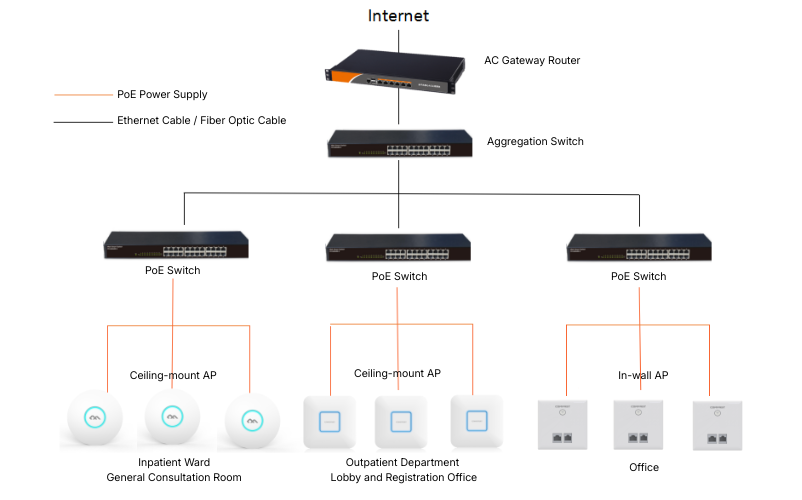
1. On-Site Survey and Precise Planning: Through field surveys of each hospital floor, combined with factors like personnel density, service attributes, and building structure in different areas, a network topology was scientifically designed, leading to differentiated equipment selection and placement strategies.
2. Scenario-Specific Differentiated Deployment:
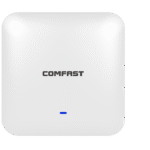
– High Traffic Density Areas (e.g., Outpatient Halls, Waiting Areas): COMFAST Gigabit Dual-Band Ceiling-Mount APs (Model CF-E355AC) were deployed for coverage. This device features high client capacity (supporting 200+ terminals), addressing access pressure during peak patient flow and ensuring smooth network performance.
– General Clinical Units and Ward Areas: COMFAST Single-Band Ceiling-Mount APs (Model CF-E320N) were deployed. Through rational placement, a single AP can effectively cover 3-4 partitioned rooms, optimizing costs while ensuring signal quality.

3. Security Isolation and Centralized Management:
– Using VLAN and Multi-SSID technology, the network was logically divided into an internal medical network and an external guest network, achieving isolation and independent security policy management.
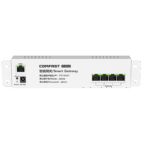
– A COMFAST Core AC Gateway running OrangeOS was employed for unified configuration, monitoring, and intelligent management of all APs, enabling load balancing, bandwidth control, and seamless roaming.
Core Advantages of the Solution
1. Stable and Reliable, Ensuring Continuity of Medical Services: Designed with high stability as a core principle, the solution ensures the smooth operation of critical medical applications like PACS image transmission and mobile nursing, providing a solid foundation for digital healthcare.
2. Multi-Layered Security, Safeguarding Medical Data Privacy: Strict network isolation, access control, and built-in security protection mechanisms effectively prevent external attacks and internal unauthorized access, ensuring the security of patient information and medical data.
3. Intelligent Management, Enhancing Operational Efficiency: A unified management platform enables centralized operation, maintenance, and status monitoring of network devices, significantly reducing the daily workload of hospital IT staff and achieving efficient, convenient network management.
4. High-Quality Experience, Promoting Harmonious Doctor-Patient Relationships: Provides patients and their families with convenient, fast free WiFi access (supporting WeChat authentication and portal push notifications), facilitating access to medical guides and entertainment while waiting, effectively enhancing patient satisfaction and the hospital’s image.
5. Scientific Deployment, Achieving Optimal ROI: Precise equipment selection and deployment based on scenario requirements avoid performance overkill and coverage blind spots. This meets the hospital-wide coverage and high-performance demands while achieving scientific control over project costs.