










Project Andaman Breeze: Outdoor WiFi Coverage and CCTV Wireless Transmission Solution for a Resort in Phuket
Contractor Team Introduction
We are a Shenzhen-based WiFi engineering contractor with extensive experience in resort WiFi coverage, hotel outdoor wireless networks, beachfront restaurant WiFi, swimming pool area coverage, villa walkway coverage, outdoor CCTV wireless transmission, parking lot camera backhaul, staff service route networks, and multi-service network separation projects. Over the years, our team has completed wireless projects for hotels, shopping areas, scenic attractions, piers, public service sites, beach resorts, and mixed indoor-outdoor hospitality environments.
A resort WiFi project is not a simple AP installation job. Guests use mobile phones, tablets, laptops, smart watches, online meeting tools, social media, cloud photo backup, streaming apps, and hotel service platforms across the pool deck, beachfront lounge, garden paths, outdoor restaurants, villa walkways, spa areas, and parking zones. At the same time, the resort needs stable staff communication, POS and ordering terminals, CCTV camera backhaul, and management access. These services must operate together, but they cannot be placed on the same unmanaged network.
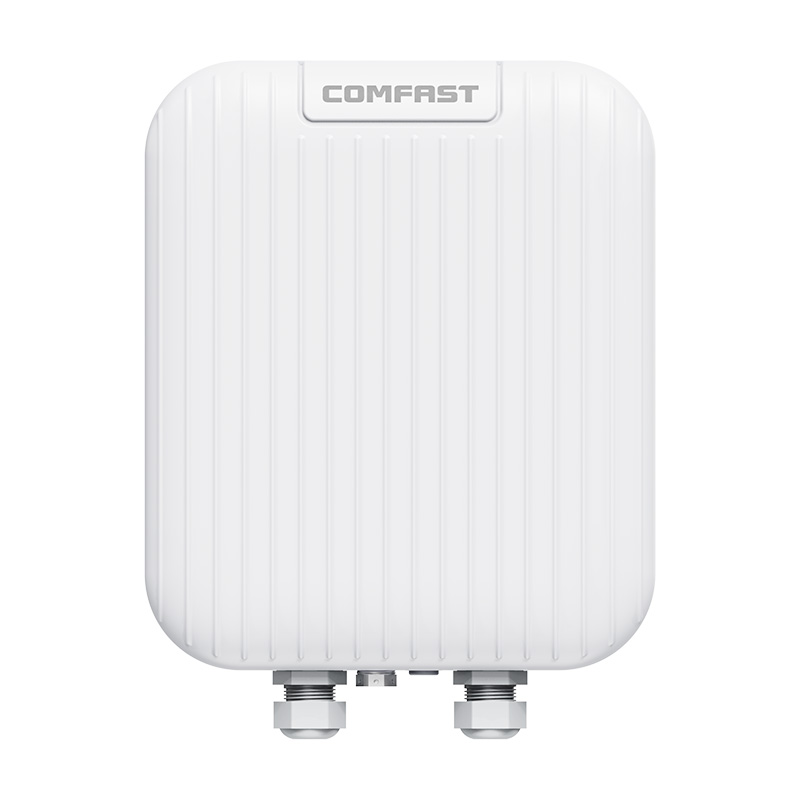
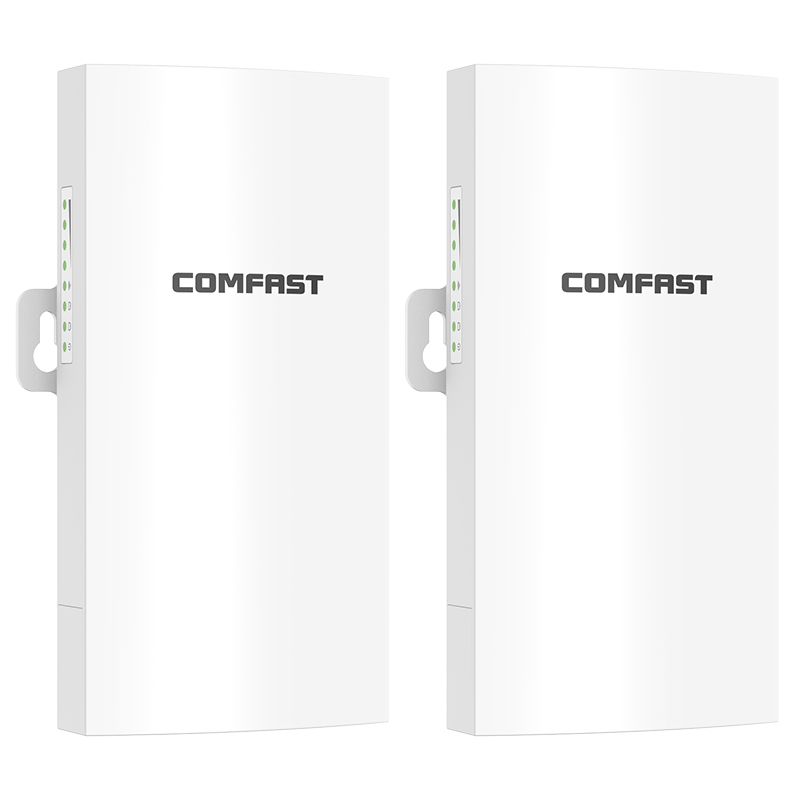
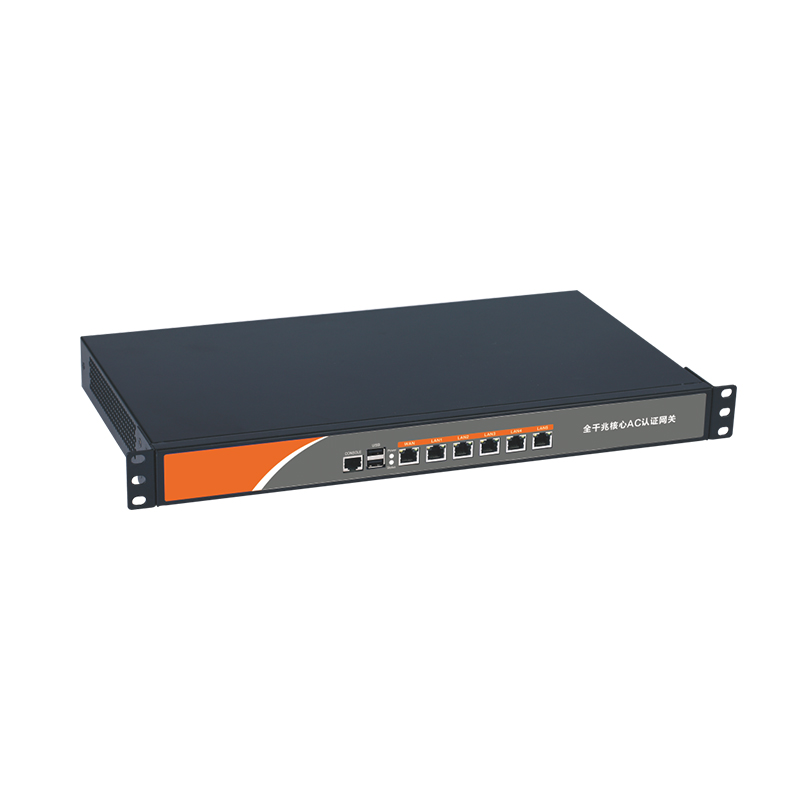
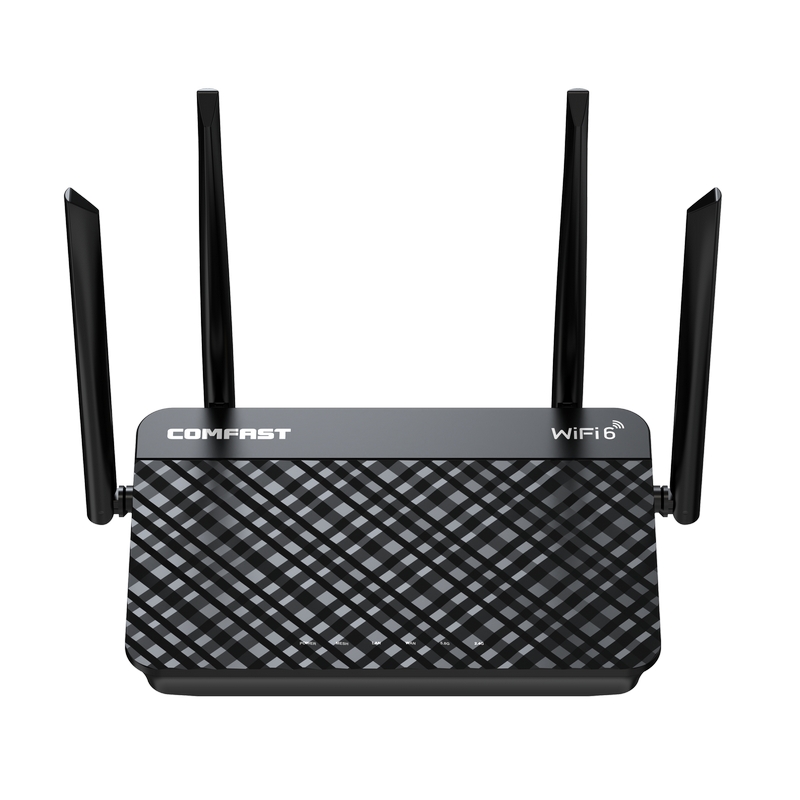
Our team has used COMFAST equipment in many resort, hotel, outdoor coverage, restaurant, parking, and CCTV wireless transmission projects. From our field experience, COMFAST outdoor APs, wireless bridges, gigabit gateways, and PoE switches are practical for tropical resort environments because they support flexible deployment, stable outdoor wireless service, centralized PoE power, clean topology, and easier long-term maintenance. For this project, we selected COMFAST CF-WA973 outdoor WiFi 7 APs, CF-EW74 V2 dual-band outdoor APs, CF-E113A V2 5.8G wireless bridges, CF-AC300 full gigabit core gateway, and CF-SG1241P 24-port gigabit PoE switch.
1. Project Overview
Project Name: Project Andaman Breeze
Project Location: Kata Beach Area, Phuket, Thailand
Project Type: Outdoor WiFi coverage and CCTV wireless transmission upgrade for a beachfront resort
Resort Scale: 132 guest villas and rooms, 2 outdoor pools, 1 beachfront lounge, 1 outdoor restaurant, 1 pool bar, 1 spa area, 1 reception building, staff service routes, garden paths, parking zones, and beach access paths
Outdoor Coverage Area: Approximately 38,000 square meters
Peak Guest Capacity: Approximately 420 guests during holiday periods and wedding event weekends
Main Service Areas: Pool deck, beachfront lounge, outdoor restaurant, pool bar, reception exterior, beach access path, villa walkways, garden corners, spa exterior areas, staff service routes, parking edges, and remote CCTV points
Project Goal: Build a stable outdoor wireless system for guest WiFi, staff network, POS and ordering devices, CCTV transmission, and centralized management without affecting resort operation or guest experience.
2. Customer Pain Points Before the Project
The resort originally relied on a mix of indoor routers, several older outdoor APs, and temporary extension points. The network looked acceptable near the reception building, but once guests moved to the pool deck, villa paths, beachfront lounge, or garden areas, the connection became inconsistent.
The pool deck had many guests using phones for photos, video calls, social media, and streaming. During afternoon peak hours, the connection speed dropped sharply because the old APs were not planned for high-density guest usage around water-facing rest areas.
The beachfront lounge had unstable WiFi, especially when guests gathered for sunset dining, wedding parties, and evening events. The old network depended too much on signal leaking from the restaurant and reception side, which was not enough for a beach-facing guest area.
The outdoor restaurant and pool bar used POS terminals and ordering tablets, but these devices sometimes slowed down when the guest WiFi load increased. The customer wanted POS and ordering traffic separated from public guest WiFi.
Villa walkways and garden corners had multiple WiFi blind spots. Guests walking from villas to the pool, spa, or beach often lost connection. Some areas were blocked by tropical plants, walls, decorative stone structures, and building corners.
The spa exterior and quiet garden paths had weak coverage. These zones did not need high-density coverage, but the resort still wanted stable WiFi for guest messaging, staff service devices, and security patrol access.
Several CCTV cameras near the beach access path, garden edges, parking area, and staff service route had unstable transmission. Pulling new cable across landscaped areas and guest walkways would have been disruptive and expensive.
The resort’s previous network did not clearly separate guest WiFi, staff devices, POS and ordering devices, CCTV, and management access. When one service became busy, other services were affected.
The tropical environment created additional issues. Salt air, humidity, sudden rain, high temperature, and outdoor cable exposure affected the reliability of older equipment and temporary wiring.
3. Customer Requirements
Provide stable outdoor WiFi coverage for the pool deck, beachfront lounge, outdoor restaurant, pool bar, reception exterior, beach access path, villa walkways, garden paths, spa exterior areas, parking edges, and staff service routes.
Support high guest density during holidays, wedding events, sunset dining periods, and poolside peak hours.
Keep POS and ordering devices stable in the outdoor restaurant, pool bar, and service areas.
Improve CCTV wireless backhaul for beach path cameras, parking cameras, garden edge cameras, service route cameras, and remote monitoring points.
Separate guest WiFi network, staff network, POS and ordering network, CCTV network, and management network by policy.
Use centralized PoE power for outdoor APs and wireless bridge devices.
Keep device installation neat and consistent with the resort’s premium beachfront appearance.
Avoid construction disturbance to guest check-in, pool operation, restaurant service, spa appointments, wedding events, and beach access.
Deliver clear handover documents, including topology diagram, AP location records, wireless bridge direction records, switch port labels, and maintenance guidance.
4. COMFAST Equipment Used in This Project
The following are the main COMFAST equipment models used in this project and their usage descriptions.
| Equipment Model |
Type | Project Use | Reason for Use |
|---|---|---|---|
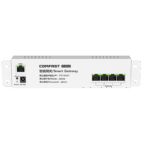
| CF-AC300 | Full gigabit core gateway | Network control, DHCP, guest WiFi policy, staff network policy, POS and ordering network access, CCTV network planning, and management access | Suitable as the resort core gateway, keeping guest traffic separated from staff devices, POS terminals, CCTV streams, and management systems |
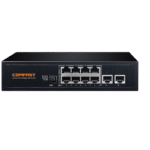
| CF-SG1241P | 24-port gigabit PoE switch | Centralized PoE power and gigabit data distribution for outdoor APs and wireless bridge devices | Reduces scattered power adapters, keeps the equipment room cleaner, and makes outdoor AP and bridge maintenance easier |
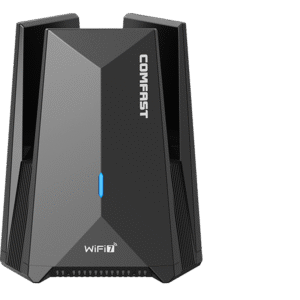
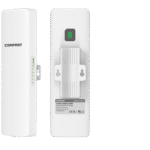
| CF-WA973 | Outdoor WiFi 7 AP | Pool deck, beachfront lounge, outdoor restaurant, pool bar, reception exterior, beach access path, and main garden area | Selected for high-density guest areas that need stronger outdoor capacity, stable WiFi during peak resort hours, and better performance for events and guest dwell zones |
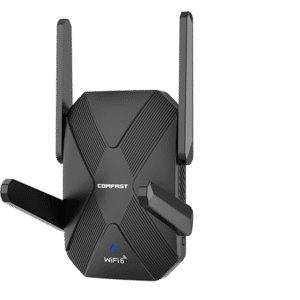
| CF-EW74 V2 | Dual-band outdoor AP | Villa walkways, staff service routes, parking edges, garden corners, spa exterior areas, and secondary outdoor paths | Used for medium-density movement zones and quiet resort areas, filling coverage gaps without overbuilding every outdoor path with high-capacity APs |
| CF-E113A V2 | 5.8G wireless bridge | CCTV wireless transmission for beach path cameras, parking cameras, garden edge cameras, service route cameras, and remote CCTV points | Avoids trenching through finished landscaping and guest walkways while maintaining stable CCTV backhaul for remote monitoring points |
5. Project Equipment Configuration Quantity
Based on 132 guest villas and rooms, 2 outdoor pools, beachfront lounge, outdoor restaurant, pool bar, spa area, reception exterior, approximately 38,000 square meters of outdoor coverage area, around 420 peak holiday guests, villa walkways, garden paths, parking zones, beach access paths, staff service routes, and remote CCTV points, the recommended equipment configuration for this project was as follows:
| Equipment Model | Quantity | Deployment Location |
|---|---|---|
| CF-AC300 | 1 unit | Main equipment room, used as the resort core gateway for guest WiFi, staff network, POS and ordering network, CCTV network, and management access |
| CF-SG1241P | 2 units | Main equipment room and outdoor distribution point, used for PoE power supply, AP connection, wireless bridge connection, uplink ports, and future expansion reserve |
| CF-WA973 | 12 units | Pool deck, sun lounger zones, beachfront lounge, outdoor restaurant, pool bar, reception exterior, beach access path, main garden area, and high-density guest gathering zones |
| CF-EW74 V2 | 8 units | Villa walkways, staff service routes, parking edges, garden corners, spa exterior areas, secondary outdoor paths, and quiet resort transition zones |
| CF-E113A V2 | 5 pairs | Beach path cameras, parking cameras, garden edge cameras, service route cameras, and remote CCTV monitoring points where direct Ethernet cabling would disturb landscaping or guest movement |
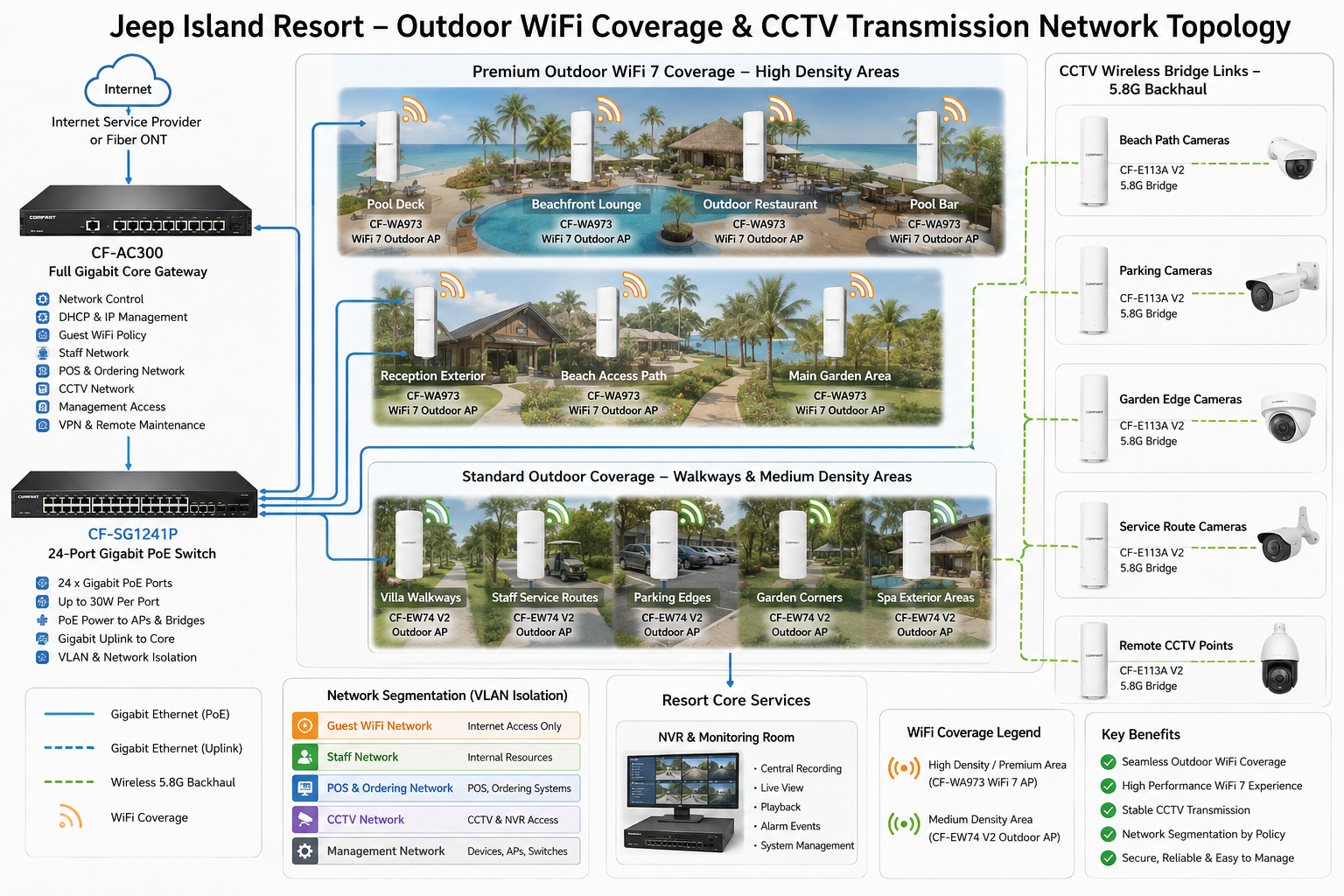
6. Project Topology Diagram
7. Site Survey and Troubleshooting Process
We started the project with a full outdoor survey together with the resort general manager, IT supervisor, front office manager, restaurant manager, pool operations supervisor, security supervisor, and maintenance team. Instead of checking the resort only from a floor plan, we walked every guest path from reception to pool, from pool to beach, from villas to spa, from restaurant to garden, and from parking to service routes.
At the reception exterior, we tested guest arrival behavior, luggage waiting points, ride-hailing pickup positions, and outdoor seating areas. This area required a stable transition from indoor service WiFi to outdoor guest WiFi.
At the pool deck, we tested signal strength, user density, AP mounting options, cable routes, and water-facing rest zones. We observed that the highest guest usage occurred around sun loungers, pool steps, towel counters, and shaded seating areas.
At the beachfront lounge, we tested sunset peak usage, event setup positions, beach-facing seating, speaker zones, and camera locations. The beachfront zone required strong outdoor AP coverage because indoor leakage was not reliable enough.
At the outdoor restaurant and pool bar, we tested POS terminals, ordering tablets, kitchen communication devices, staff handheld devices, and guest WiFi load. We confirmed that POS and ordering devices needed a separated network policy.
Along villa walkways, we checked building corners, landscape walls, trees, garden lighting poles, and guest walking routes. Many weak points were caused by tropical planting and curved paths rather than long distance alone.
Around spa exterior areas and garden corners, we tested quiet rest areas, service access paths, and hidden corners used by security patrols. These areas required reliable medium-density coverage, not oversized high-power coverage.
For CCTV transmission, we inspected beach path cameras, parking cameras, garden edge cameras, service route cameras, and remote monitoring points. For each CF-E113A V2 wireless bridge link, we confirmed line of sight, mounting height, tree obstruction, power source, waterproof cable path, and serviceability.
We also inspected the main equipment room. The old cable labeling was incomplete, and several outdoor cable routes were not documented. Before installation, we created a new port plan, AP map, bridge direction plan, and maintenance labeling format.
8. Problems Found During Implementation
The old resort network was extended gradually over time, but it was not designed as a complete outdoor WiFi system. Several APs covered small areas, but there was no consistent outdoor RF plan for guest movement, pool density, restaurant service, beach events, and CCTV transmission.
The pool deck issue was not only a signal problem. It was a high-density guest usage problem. Guests stayed for long periods while using cloud photo backup, social media, video calls, and streaming apps. We used CF-WA973 APs in this zone because it needed higher performance outdoor WiFi.
The beachfront lounge needed dedicated outdoor coverage. The old system relied on nearby indoor equipment, but the beach-facing guest area had different density, different direction, and different event patterns. We treated it as an independent outdoor coverage zone.
The restaurant POS and ordering terminals were affected by guest WiFi traffic. We separated POS and ordering traffic from guest WiFi to improve service reliability during lunch, dinner, and pool bar peak periods.
Villa walkway blind spots were caused by walls, turns, trees, and landscape structures. We used CF-EW74 V2 outdoor APs to fill medium-density guest movement paths without overloading the area with unnecessary high-power transmission.
CCTV cabling to remote garden and beach path points was not practical. New cable work would have affected landscaping, guest paths, and daily resort operation. CF-E113A V2 wireless bridges gave the resort a more efficient way to return video from remote camera points.
Outdoor equipment had to survive Phuket’s real environment. Salt air, humidity, heat, and rain required better cable protection, cleaner mounting, and more careful selection of equipment positions.
Construction could not disturb guests. Work around the pool, restaurant, spa, beach access, and villas had to be scheduled around check-in times, breakfast service, pool peak hours, wedding setup, and evening dining.
9. Final Engineering Solution
The CF-AC300 full gigabit core gateway was deployed as the central network control point. We separated guest WiFi, staff network, POS and ordering network, CCTV network, and management network by policy, so public guest traffic could not interfere with payment, ordering, CCTV, or management devices.
The CF-SG1241P 24-port gigabit PoE switch was installed in the main equipment room to provide stable PoE power and gigabit data distribution for outdoor APs and wireless bridge devices. This made outdoor device power cleaner and easier to troubleshoot.
CF-WA973 outdoor WiFi 7 APs were deployed in high-value, high-density guest areas. These included the pool deck, beachfront lounge, outdoor restaurant, pool bar, reception exterior, beach access path, and main garden area. Their placement was based on guest dwell time, seating density, and event usage patterns.
CF-EW74 V2 dual-band outdoor APs were deployed in medium-density zones such as villa walkways, staff service routes, parking edges, garden corners, spa exterior areas, and secondary outdoor paths. These APs provided stable coverage for movement zones and quiet resort areas.
CF-E113A V2 5.8G wireless bridges were deployed for CCTV backhaul from beach path cameras, parking cameras, garden edge cameras, service route cameras, and remote CCTV points. This avoided disruptive trenching and protected the resort’s landscaping.
After installation, we adjusted AP direction, channel planning, transmit power, and coverage overlap. We did not solve the project by simply increasing AP power. In a resort environment, excessive power can create interference, sticky clients, and poor roaming. We tuned the network according to real guest movement.
10. Different Area Network Design
Pool Deck Coverage: The pool deck was treated as a high-density guest dwell area. CF-WA973 APs were mounted to cover sun loungers, pool paths, towel counters, shaded seating, and poolside service points. Coverage was tuned to avoid unnecessary overlap with villa areas.
Beachfront Lounge Coverage: The beachfront lounge needed stable WiFi for sunset guests, wedding events, dinner service, and staff handheld devices. CF-WA973 APs were positioned to cover seating zones and event areas without exposing equipment to direct beach activity risk.
Outdoor Restaurant Network: The outdoor restaurant used CF-WA973 coverage and a separated POS and ordering network. POS terminals, ordering tablets, kitchen communication devices, and receipt printers were protected from guest WiFi traffic.
Pool Bar Network: The pool bar required reliable ordering and payment access during afternoon peak hours. The AP position considered bar counter location, staff movement, guest seating, and wet-area safety.
Reception Exterior Coverage: The reception exterior was designed as a transition zone between indoor service and outdoor guest movement. Guests arriving by shuttle, taxi, or ride-hailing service could stay connected during check-in and luggage waiting.
Beach Access Path Coverage: The beach access path needed both guest WiFi and CCTV camera support. CF-WA973 APs provided guest coverage, while CF-E113A V2 wireless bridges returned camera video from hard-to-cable points.
Main Garden Area Coverage: The main garden area was used for walking, photography, evening events, and small gatherings. AP locations were selected to blend with the resort environment and avoid visual clutter.
Villa Walkway Coverage: Villa walkways used CF-EW74 V2 outdoor APs. These APs covered curved paths, garden walls, and room-to-pool movement routes without overbuilding the area.
Staff Service Route Network: Staff service routes required stable access for housekeeping, engineering, room service, and security patrol teams. CF-EW74 V2 APs provided practical coverage for staff communication and operational devices.
Parking Edge Coverage: Parking edge zones used CF-EW74 V2 APs and CF-E113A V2 wireless bridge links for camera return. This improved parking monitoring and staff mobile access without extensive cable work.
Garden Corner Coverage: Garden corners had coverage shadows caused by trees and landscape structures. CF-EW74 V2 APs were placed to cover these medium-density zones and improve guest path continuity.
Spa Exterior Coverage: The spa exterior required stable but quiet coverage. APs were positioned discreetly to protect the resort’s relaxed environment while supporting guest messaging and staff service devices.
CCTV Wireless Transmission: CF-E113A V2 wireless bridges were used for beach path cameras, parking cameras, garden edge cameras, service route cameras, and remote CCTV points. Each bridge link was aligned, labeled, tested, and recorded for future maintenance.
11. Outdoor AP Installation Details
Outdoor AP installation was planned around both RF performance and resort appearance. We avoided messy cabling, exposed adapters, visually intrusive mounting positions, and guest-touchable locations. The goal was to make the wireless system work well while keeping the resort’s premium look.
At the pool deck and beach areas, APs were mounted away from direct splash, guest contact, and service cart movement. Cable routes used protected paths, and AP direction was adjusted to cover seating and walking zones rather than open water.
Along villa walkways and garden paths, APs were mounted near lighting poles, service structures, or concealed wall positions where possible. We avoided damaging trees, decorative walls, and landscape features.
For spa and quiet areas, we selected lower visual-impact mounting positions. These zones needed reliable coverage but did not require the same high-density design as pool and beachfront areas.
All outdoor cable routes were checked for rain exposure, drainage direction, service access, and long-term maintenance. Outdoor equipment was labeled and documented before final handover.
12. Wireless Bridge Transmission Design
Beach path cameras used CF-E113A V2 wireless bridges because new cabling along the beach path would have affected guest movement and landscaping. The bridge link was aligned to avoid palm tree obstruction and seasonal decoration structures.
Parking cameras used wireless bridge backhaul where direct cabling would have required pavement work or long outdoor cable exposure. The final link improved camera stability and simplified future maintenance.
Garden edge cameras were difficult to cable because of landscape irrigation lines and guest walking paths. CF-E113A V2 bridges provided stable CCTV transmission without opening the ground.
Service route cameras were connected through bridge links to improve security monitoring for staff movement, supply delivery, and engineering access routes.
Each bridge link was tested for signal level, video continuity, night camera stability, NVR preview, playback quality, and alignment reliability. We recorded the source point, destination point, mounting direction, and maintenance note for each link.
13. Network Segmentation and Security Design
Guest WiFi Network: The guest WiFi network served pool guests, villa guests, beachfront lounge users, restaurant guests, spa visitors, and event attendees. It provided internet access without exposing staff devices, POS terminals, CCTV, or management equipment.
Staff Network: The staff network supported housekeeping, room service, engineering, front office, security patrol, and restaurant staff devices. This network was separated from public guest WiFi.
POS and Ordering Network: POS terminals, ordering tablets, receipt printers, kitchen communication devices, and pool bar service devices used a dedicated POS and ordering network. This protected guest service operations during peak hours.
CCTV Network: CCTV camera traffic from bridge-connected cameras was separated from guest and staff traffic. This improved monitoring stability and simplified troubleshooting.
Management Network: The management network was reserved for the CF-AC300 gateway, CF-SG1241P PoE switch, outdoor APs, wireless bridges, and authorized maintenance devices. Access was limited to resort IT staff and approved engineers.
14. What We Did Differently from Other Engineering Teams
We did not simply extend reception WiFi toward the beach. A resort outdoor network must be designed around guest movement, outdoor seating, pool density, restaurant service, villa paths, staff routes, CCTV points, and environmental conditions.
We did not judge the design only by signal bars. We tested poolside guest density, beachfront sunset peak traffic, restaurant POS stability, villa walkway roaming, garden corner blind spots, staff service routes, and CCTV video return.
We did not put guest WiFi, staff devices, POS ordering, CCTV, and management equipment in the same network. Each service received its own policy to reduce interference and improve security.
We did not solve every issue by increasing AP power. In a resort environment, high power can create roaming problems and interference. We adjusted AP placement, direction, channel, and power based on actual guest zones.
We did not trench across guest paths and landscaped gardens when a wireless bridge solution could solve remote CCTV transmission more cleanly. CF-E113A V2 bridges reduced construction impact and protected the resort environment.
We did not interrupt guest operations. Construction was scheduled around breakfast service, pool peak hours, wedding setup, restaurant dinner service, spa appointments, and check-in periods.
We did not leave unclear equipment records behind. The customer received AP location records, switch port labels, bridge direction records, topology notes, and maintenance guidance.
15. Project Acceptance Results
Pool deck WiFi coverage test passed.
Beachfront lounge WiFi coverage test passed.
Outdoor restaurant POS and ordering network test passed.
Pool bar ordering terminal test passed.
Reception exterior guest WiFi test passed.
Beach access path coverage test passed.
Main garden area coverage test passed.
Villa walkway roaming test passed.
Staff service route network test passed.
Parking edge WiFi and CCTV backhaul test passed.
Garden corner coverage test passed.
Spa exterior coverage test passed.
CF-E113A V2 wireless bridge video transmission test passed.
CCTV live preview and playback test passed.
Guest WiFi, staff network, POS and ordering network, CCTV network, and management network isolation test passed.
AP labels, switch port records, wireless bridge direction records, topology diagram, and maintenance handover were completed.
16. Customer and User Feedback
Resort General Manager Feedback: “The outdoor guest experience improved significantly. Guests now have better WiFi at the pool, beach lounge, restaurant, and garden areas, and our service systems are more stable.”
IT Supervisor Feedback: “The network is much easier to manage now. The AP map, bridge records, port labels, and separated networks make daily troubleshooting faster.”
Restaurant Manager Feedback: “Ordering tablets and POS devices are more reliable during dinner service and pool bar peak hours. We no longer worry about guest WiFi traffic affecting payments.”
Front Office Manager Feedback: “Guests stay connected from the reception exterior to the pool and beach path. The arrival experience feels smoother.”
Security Supervisor Feedback: “The camera feeds from the beach path, parking area, garden edge, and service route are more stable after the wireless bridge upgrade.”
Housekeeping Supervisor Feedback: “Staff communication along villa walkways and service routes is better. The team can update work orders without walking back to the office.”
Guest Feedback: Several guests reported smoother WiFi around the pool deck, beach lounge, and outdoor dining area, especially during sunset hours and evening events.
17. Project Summary
Project Andaman Breeze was a successful outdoor WiFi coverage and CCTV wireless transmission project for a beachfront resort in Phuket. The project solved pool deck congestion, beachfront lounge instability, restaurant POS interference, villa walkway blind spots, garden corner weak coverage, spa exterior coverage gaps, parking camera instability, beach path CCTV backhaul issues, and unclear network separation.
The final COMFAST solution used the CF-AC300 full gigabit core gateway, CF-SG1241P 24-port gigabit PoE switch, CF-WA973 outdoor WiFi 7 APs, CF-EW74 V2 dual-band outdoor APs, and CF-E113A V2 5.8G wireless bridges. This combination supported high-density guest WiFi, medium-density walkway coverage, staff service access, POS and ordering stability, CCTV wireless backhaul, and centralized management.
The key value of this project was not simply installing more APs. The real value was designing the resort network around guest behavior, beachfront usage, poolside density, restaurant service reliability, villa path roaming, tropical outdoor conditions, CCTV transmission, visual appearance, and long-term maintenance.
18. Lessons Learned and Advice to Other Contractors
Resort outdoor WiFi must be designed around guest behavior, not just square meters.
Pool decks and beachfront lounges are high-density dwell zones, so they require stronger planning than normal walkways.
Restaurant POS and ordering devices must be separated from guest WiFi traffic.
Villa walkways and garden paths need coverage continuity, but not every path requires the same AP type or density.
Outdoor AP placement must consider rain, humidity, salt air, guest contact, visual appearance, cable protection, and service access.
Wireless bridges are effective for CCTV points where cabling would damage landscaping or disrupt guest areas.
Do not test only at noon. Test pool areas in the afternoon, beachfront zones near sunset, restaurants during service peaks, and cameras at night.
Do not leave the customer with unlabeled devices and unclear cable routes. Handover documentation is part of the engineering result.
For beachfront resort projects, engineers must balance performance, appearance, safety, guest comfort, and maintenance. A strong signal alone is not enough. The network must support real resort operations, including guest WiFi, restaurant service, staff communication, CCTV monitoring, and management access.
A Resort Outdoor WiFi Coverage Solution is complete only when guests stay connected, POS devices remain stable, staff can work efficiently, cameras return clear video, outdoor equipment is protected, and the resort IT team can maintain the system confidently. That was the standard we delivered for Project Andaman Breeze.